Distant, yet personal, visual but emotional; The Tree of Life delves deep into the heart of humanity. The gritty truth where we experience a fierce change. The front row seat in this experience we all go through is an evident and blatant portrayal of who we are: fallen members of creation. The heart of human struggle is put on display with the asking of a few questions: what is our nature? Are we good or evil? If there is one thing to learn from this film, if there is one element we need to walk away with it is this: This film shows who we are.
Terrence Malick has received acclaim for this film, and rightly so. It is a beautiful work, an example of hidden struggle he must have went through. However, the human view of Malick sees him as a genius, he gains the glory from them. In reality, Malick has shown that that is the opposite thing he wants. Tree of Life won the Palm D'or at the Cannes film festival, but he has not made many appearances in front of the media. I believe this reclusiveness is because he wants the audience to look at the film, and look at themselves. Malick's intimate story shows that he believes in toiling the earth, God's curse upon man. Malick is just a man. Watching the Tree of Life is a glimpse of Malick's toil.
Though the performances by the stars were fantastic, the brights performers in this film were the young actors. Pulling their weight against Hollywood heavyweights, the young actors performed so naturally, you are forced to wonder if the camera was ever even there. They were real.
The Tree of Life is a beautiful film. Malick uses a very gradual rising action to get to the heart of the story. It you expect to immediately be in a narrative, you will find yourself wanting immediately. Wait, let the momentum build and when the actual story hits in, you will be thankful you waited.
I recommend The Tree of Life. Watch it, experience it, and let the story entrance you.
Sunday, May 29, 2011

Thursday, February 10, 2011
Ante Up
Here is a link to the Short Film I directed last spring. Comment, Critique, Enjoy!
http://www.vimeo.com/19762545
http://www.vimeo.com/19762545
Tuesday, February 8, 2011
Top Five Sites for Filmmakers
Sharing and collaborating is an important part of nearly every profession, but it is vital in the film making business. I decided that it would be a good idea to share the top five websites I visit regarding how to improve as a film maker. Here Goes:
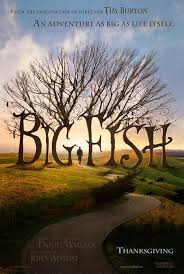
Why? John August is a writer/director who has been in the business for about 20 years. He has been a favorite of Tim Burton for a while, writing Big Fish, The Corpse Bride, Charlie and the Chocolate Factory(the new one...duh) and a few others. August knows the Hollywood system of execs, directors, writers and insiders. His blog hits several key aspects of the industry including writing and directing. He's smart and straightforward with his posts. Also, he is a great writer. I'd encourage you to watch The Nines.
4. The 99%
Wait...this site isn't a film site? Whats the deal with this site? Why? The 99% is a site for creative leadership/individuals, so naturally that fits for film. There are tons of great articles on leadership, productivity, collaboration, discipline and a number of other topics. Every article I've read on the site can be related to film making in some aspect. Its clear and easy to navigate and has a lot of great stuff to say.
3. ScriptShadow
A daily blog run by a guy who reads scripts, both professional and amateur, and writes reviews that are constructive; pointing out the strong suits and the weak points in the scripts. He knows what he is talking about. Also, you can send your scripts to him for a beating. He doesn't review every script, but if you have a good logline, he may choose to review it. If you want to be a director, its a good idea to read scripts because you will be doing that for a living. Producers can find great info about what to look for in a script and writer...well its one of the best sites for writers simply because of all the reasons stated above.
Another blog run by a screen writing professor from the University of North Carolina, and he also teaches out of the Writers Extension Program at UCLA. He has had a few scripts produced in the late 80s/early 90s. Essentially, he has the accreditation you'd want from a writing professor...and he teaches (for the most part), his classes on his blog. He posts nearly bi-hourly, and he posts a TON. Anything from produced scripts to tips from writers, to interviews with them, directors and anything else you can think of regarding film making. Also, the guy replies to emails and comments. I sent him an email not expecting to hear back and he wrote back within a week. There is an extensive library of info on his site, so it will take you a lifetime of reading if you want to know everything he has posted, but I recommend taking a look at his archives.
1. Zoetrope
Zoetrope is a website created by the one and only Francis Ford Coppola, director of The Godfather trilogy and Apocalypse Now. The site is an enormous virtual studio for nearly all aspects of the creative film making process. You are able to post, read, review and be reviewed by professionals, amateurs and people who like to read scripts. I've had two of my short scripts reviewed by a number of professionals and reggos alike. It's a fantastic form of collaboration. I've had several scripts sent to me by people interested in having them made. There are rules and regulations on the site that help control theft of ideas, so you are OK to post nearly anything you've made.
That's it. Go check the sites out, visit them and let me know what you think.
Do you have any sites you like to visit? Post them in the comments section so I can check them out and share them with others as well.
Sunday, February 6, 2011
A Note of Congratulations
I'd like to congratulate the Green Bay Packers for the rough season they experienced and the Super Bowl trophy they won. Injuries plagued the team throughout the season, and some of that crept into this game; they lost a key player on both sides of the ball, but they still pulled it out. Way to be a tough franchise and get the win in the end.
I used to dream of playing football as a kid, my parents had to sit me down in 9th grade and explain how I wasn't good enough to make it, in nice words: "Mike...if you want to play in the NFL you're going to want to grow six inches taller and become fast...maybe you should be a plumber?"
Love my parents. If it weren't for them I wouldn't be a film maker.
Hope you enjoyed Super Bowl XLV.
I used to dream of playing football as a kid, my parents had to sit me down in 9th grade and explain how I wasn't good enough to make it, in nice words: "Mike...if you want to play in the NFL you're going to want to grow six inches taller and become fast...maybe you should be a plumber?"
Love my parents. If it weren't for them I wouldn't be a film maker.
Hope you enjoyed Super Bowl XLV.
Friday, January 21, 2011
Koalas Can Change the Weather?
Perhaps you've heard of it, or not. But the movie "The Nines" is one of the most underrated movies I've seen the a while. The thematic elements wove into the entertaining story are pretty interesting and difficult to think about. Earlier this week I posted a blog about the film "Apocalypse Now," another great thematic driven story. I wrote about the movie in a class called Deconstructing Cinema. "The Nines" was another film I wrote about for the class.
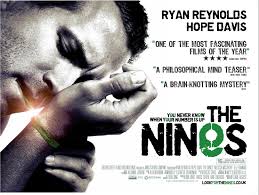
If you don't like spoilers, please don't read this blog. I hate reading reviews that spill the beans regarding a film and I don't want to be apart of ruining a movie for you. Here were my thoughts on the film "The Nines"
The Nines was a great film that falls under the genres of drama, mystery and fantasy. Set in modern times, the winding truth within each different world is revealed little by little over the course of what would seem to be only a few days. Ryan Reynolds is a character who is, above all other things, lost and confused. His existential breakdown in act one is lead by one statement: “there is something wrong with the world.” His goal of understanding his world around him becomes a goal of actually finding what is wrong with it, which changes again to a goal of getting his created world “on the air,” and finally in part three, his goal becomes one of fixing what he can in the world he knows. The motivation that connects the three worlds together is to stay connected, in community with the world he has created.
The main character, who I will refer to as Ryan, is a deity who has created realities for himself and lived in them so long they have become a drug. This allegoric story shows the broken view of a creator but an honest and broken view of humanity. John August, the writer/director of the film, has made a story of a god who is a 9: not quite omnipotent and omniscient, but close. Augusts’ view of this god seems to limit the power of these creating beings. What I find interesting is the idea of humans limiting the power of deities. It is a historical act. Zeus was unable to control the other gods on Mt. Olympus and even had to fight more powerful monsters. The film does suggest an all powerful being, one that would be a “10,” however, this still limits the number of potential power to a 10. The God of our faith is one whose power is not able to be comprehended or seen in full and to label a god with 10 still limits his potential. It is simply an interesting fact that we as humans try to grasp and control the world we live in.
Humanity is shown in this film as a dimwitted creation that chooses to live in ignorant bliss. What a truthful commentary on the nature of man. Looking around our western society, it is obvious that we choose to ignore and suppress the view of the world into terms of our own control. The Nines makes man an ignorant, mindless pawn. What more are we if we do not attempt to understand our existence and purpose? Now, I believe John Augusts view of the world lines more correctly up with being a 9. We create realities for ourselves and we choose to have tunnel vision inside these worlds. To some extent we will never be able to see and understand all aspects of the world, but we do have the ability to know and understand these realities.
We find drugs in our world, physically or metaphorically, and we addict ourselves too them. Ryan Reynolds does that to these worlds. He manifests these existences, 90 in all, and involves himself so much, that he forgets his own home. These “drugs” are the defilement of our worlds, they are sin. We lose sight of the true reality in which we need to live, and take a hit of the false ones that warp our worldview. The story shows a shrinking world with each new character: the actor’s world being the largest, a world he could move through doing whatever he wills. Then it shrinks as he goes on probation, and it shrinks even more as he violates his own rules in the reality (trippy…). Within the second reality we are shown a writer whose world may seem free running, but is not because it is being shown as a docudrama: a world caught in the bounds of a non-existent camera crew. Finally, we see the last world: a highly filmic desaturated reality that was written about by his former self, the writer.
These realities, when compared to our own, show a sort of refusal to accept the truth of a larger world outside our own. On a personal level, I relate to this view of life, especially the showrunner version of Ryan Reynolds because he is a creative near in the same field I am in. The idea of creating a world where I can be a showrunner is tantalizing and perhaps in the future it is possible. Yet, my thoughts linger to the truths I feel the film points out: our realities are tunnel visions and we can mistake what we need to focus on and step over our friends, neighbors and those we love. Our world is full of temptations that become our world, something that we need to avoid as Christians.
Thematically, The Nines wrestles with a creator’s relationship with his world/his creation and vice versa. On a more direct level, I believe the film is about the addictions we have and the perceptions of reality we have because of those addictions. When the film ends we are, at first, sure our world is destroyed or in better words inanimated, or nullified. But we see that the love the creator 9 makes him bring the world in to existence. This ending signifies to me a possible view of how John August believes God is.
When examining this film as a piece of cinema, I place it among others such as Inception and Memento in terms of the perception of reality. It is not a straightforward, simple, story you are forced to think about what it means. Other films that share common thematic elements are Bruce Almighty, and Evan Almighty. Both of these films discuss the deity of God and his relationship with creation, though neither film forces as much thought to be placed on said subject.
In terms of where this film appears in the canon of the writer/director, it is his feature directorial debut. John August is not an unknown man in the film community, as his writing career has been quite busy. John has written several films for Tim Burton including Big Fish, Charlie and the Chocolate Factory and Corpse Bride. He has also written both Charlie’s Angels re-make films. He has also been an uncredited writer for Iron Man and Jurassic Park III. As a director, John has written and directed one other film as a short called God.
The world of the film was not in any way significantly heightened but did a great job of fulfilling the needs of the production. However, everything was intentional in the film. The color pallets reflect the mood of each piece of the film. The most interesting part of the production design that reflected the themes of the film, was the car. Every car that was owned by Ryan Reynolds character was an environmentally friendly car. It further revealed the character’s love for the environment and world.
The cinematography was very intentional throughout the entire film. John August chose specific film stock and video type to depict the world his story called for. The first segment of the film was shot in 16mm, a medium that was used to create a film look but wasn’t so grainy that it made the world seem surreal. Next, aforementioned is the second section that was shot in a reality show method. This part was actually filmed in standard definition, though it is a high quality. This effectively captured a world that was compact to what we were watching within its bounds on screen. Finally, the last segment of the film was shot on 35mm. In this highly stylized environment, the world is painted so it has a surreal look, feeling almost like a horror movie. The idea is alienating to the audience after we have been subject to two styles of filming that have a more personal feel to them. Looking at these three styles it is clear there was purpose to them. Each segment says something to the audience; it is the audiences’ relationship with the film itself. The choice of shooting a film this way further reinforced the connectedness of our main character, his world, the human world, and our world.
Even the very sound of the film has an immediate connect to the intentionality of the story. Specifically, while in the second part, the showrunner is having his star record ADR. This was important because while in the third part, we actually hear this line being said, despite the creator’s objection to the line. Outside of dialogue, the sound captured effectively reflected each style of camerawork that was chosen for each section.
The Nines was obviously a work that reflects a worldview tied to Christian beliefs in some way. It was never blatant and never claimed religion outright, but reflected thoughts of a created world with a creator. Relating to this film, as a human it is easy to limit the creator’s power in our mind, which is a distorted view of the creator, because he is unboxable. Humans find themselves addicted to their own lives; no one is immune to this possibility. As a film that was not, and is not, marketed as religious cinema it clearly has some belief injected throughout.
Elementally, this film was entertaining, thoughtful, deep and well made. “Variety,” reviewer, Dennis Harvey agrees: “the mix of authorial imagination and precision on display is most impressive, and in his first such effort August directs with as much alert confidence as he writes.” The Nines found an audience with mediocre reactions, only a 6.6 on IMDb, though the fanboy website may be far too pumped with high energy blockbusters like Transformers to appreciate the intelligence throughout this film.
Wednesday, January 19, 2011
I Love the Smell of Apocalypse in the Morning
This past week I've been taking a class called Deconstructing Cinema. It isn't your average class as you are required, yes required to watch two films per day. After watching these movies we contribute to discussion boards about the film and write five papers over the course of two weeks. Sounds fun, doesn't it? Well it is. However, that does not mean it was all fun and games. The professor chose movies that are not exactly the easiest to watch, getting us out of our usual Hollywood mix up.
The class has been broken up into a few different sections: Introduction/Behind the Scenes, Experimental/Foreign, God in Cinema, Classics and Coen. Some films included in the class are: Romeo+Juliet (with commentary), Brazil (plus Battle for Brazil), Ink, Traffic, Crash, The Seventh Seal, The Nines and Apocalypse Now.
After watching Apocalypse Now, I was moved by the themes and visuals. The film itself is incredible, but the story behind the film is truly a piece of inspiration. If you have never heard of either Apocalypse Now or the behind the scenes making of film Hearts of Darkness perhaps you should turn back now, find both and spend the time watching them. It's an important piece of cinema for a number of reasons. Last week I watched the movie for the first time, below is my analysis.
Francis Ford Coppola directed this film, which he would claim is not a movie about Vietnam, but it is Vietnam. Coppola and his film cast and crew were in the jungles of Asia for 238 days, on the door step of actual military strikes and the true dangers of the jungles. Fighting to keep the cast, crew and his film alive, Coppola forced himself to the brink to create this piece of important cinema. It has been said that making a film is like going to war. There is no truer example of this statement than this movie.
Apocalypse Now is an epic war film set in 1970 during the Vietnam war loosely based on the 1902 novella “Hearts of Darkness.” Captain Willard is played by Martin Sheen, a glazed over Special Forces officer given a classified mission into Cambodia to seek out a crazed rogue Colonel Kurtz and bring him to swift justice. Willard is the hero of the film; he reluctantly accepts the mission and embarks on a journey of self reckoning and spiritual awareness. His motivation to stop Kurtz is, at first, simply an objective to be completed. His motivation to finish the mission stems from his natural obedience as a soldier.
Willard begins his fateful mission by joining a Navy Patrol Boat, Riverine named “Erebus,” Greek for deep darkness or shadow. The crew from the boat serves as an example of innocence and naivety as shown by the water skiing at the mouth of the river. This crew encounters and rendezvous with the 9th Air Calvary, commanded by Lieutenant Kilgore during a strike against the VC. Here we meet a prime example of a weathered, American war machine. Kilgore is a soldier. Walking through combat mortars and bullets whizz by his head; Kilgore stands completely unaffected, it is clear this is not his first rodeo. Despite his experience as a soldier Kilgore grasps onto a tradition that in essence describes the war in Vietnam perfectly. Kilgore is a surfer and he will stop at nothing to find a suitable place to do so in the heat of the war. When Captain Willard and his boat crew come across Kilgore, Kilgore is hesitant to help the captain along his journey, but when surfing becomes a possible outcome he is completely willing to jump in a fleet of helicopters and fight for his one once of pleasure. Insanity.
After passing through this stage, Willard and the boat crew continue down the river toward their objective. The road becomes more perilous as we continue on the Erebus toward the looming end of the river. At one point the soldiers stop the boat at dusk and Willard and one of the crew, Chef, trek into the jungle. The darkness shrouds the men as they find themselves not alone in the heat. The men encounter a tiger, which frightens Chef and sends him screaming back to the boat. Willard then tells the crew to never leave the boat, which ironically is part of the doom of all the men who stay on board.
After several more encounters that pulsate with less than sane thematic we find our crew becoming less and less comfortable with themselves, the environment and especially Willard. Eventually the men all succumb to “Lord of the Flies” type fates as they find themselves on a journey not unlike Willard’s. Throughout the movie, Willard is encountering signs of Kurtz and the ominous doom ahead, yet we are taken on the ride with Willard and find him questioning the war, himself and Kurtz actions; is he wrong? The native people see Kurtz as a sort of god, and as our heroes journey closer to this deity it is clear he is one of primal, deceptive and dark natures.
When Willard finally reaches Kurtz in the heart of the wild jungle two of the crew have perished and the remaining members are lost in the insanity of the experiences they have had on the journey. Kurtz is surrounded by an entourage of natives revering his very presence, dead bodies of both American and VC soldiers, a tripped out American photographer and, perhaps worst of all, an assassin who came before Willard on the exact same mission. The omens of success are non-existent as we see the insanity of the war piling high on Willard’s conscience. Kurtz brilliance as a tactician is over shadowed by the fact that he seems immortal and omniscient, unable to be stopped by anything but an all out bomb strike, a looming “apocalypse” of its own.
When Willard is in his darkest place, the audience is lead to believe he is unable to complete his objective, or perhaps he has completely abandoned it in pursuit of following Kurtz into madness. However, Kurtz, the omniscient force of evil sees the true nature of Willard and releases him to carry out his will. Kurtz and Willard are both descending characters. Kurtz has reached the final tiers of darkness and madness while Willard is on the edge of his own stability and even loses himself temporarily in the madness that permeates from Kurtz. However, Willard finally sees the depth of Kurtz evil and recognizes that he himself could become Kurtz. Willard does complete his mission, but immediately afterward we see the potential for Willard to take the place of Kurtz, Willard could become the new face of evil. Willard steps away from this tantalizing prospect as he has seen the debilitating effects of such a fate.
The film works as an allegory, using the themes of morality, good and evil and insanity to showcase the horrible events of the Vietnam War. It depicts some of the most graphic scenes in film history and wages its own war on the purposes behind the actual conflict. The film itself chooses to defend the notion of sanity and morality through diving head first, ten feet down into the questionable events of the war. Coppola himself experiences the actual events of the conflict through creating this film with the odds stacked against him and ends up questioning his own sanity as the process seems doomed from day one.
Coincidentally, Apocalypse Now is the 13th film Coppola directed. Apocalypse Now was the film Coppola felt compelled to make, but was unable to do so through studios because of its touchy subject matter. Coppola used his own money to finance the movie. After becoming a critical success with the Godfather films, Coppola embarked on creating Apocalypse Now. The film is considered one of the most important in cinema history: “’Apocalypse Now’ is more clearly than ever one of the key films of the century.” (Ebert, 1999).
The process of making this film has been documented in the film “Hearts of Darkness,” and is critiqued, discussed and written about by film scholars and students today. The documentary reveals George Lucas, a friend of Coppola, telling his friend: “if you go over there as a big Hollywood production they’re going to kill you. The longer you stay the more in danger you are in of being sucked into the swamp.” (Hearts of Darkness). It is clear the creation of this film and the film itself belong among the top cinematic events from the repercussion, reception and critical response of the masses.
The film was nominated for eight Academy Awards and won for Best Cinematography and Best Sound. The awards were well deserved as the photographic beauty of the film is unquestionable. Shot selections, camera angles and movements were chosen so masterfully as an audience member it felt as if I was experiencing the events Willard and company went through. Specifically, there is a shot that was a threshold, a gate to the world of Kurtz and that shot was of the crashed plane in the river; when the boat traveled underneath the tail of the airplane into the deepest ravines of Kurtz jungle. The lighting created a semi-surreal environment, especially when the sun was rising or diving below the trees. The visual theme of darkness was perfectly executed throughout the movie. The wild night was captured so well it encompassed me as an audience member and gave me the actual feeling of dark, unending, evil insanity.
The sound captured a resonating explosion of film greatness with the napalm infused jungles. When Kilgore and his cavalry descended on the nearly helpless village by the sea, Wagner’s “Rise of the Valkyries” boomed through the speakers on ever helicopter. This beautifully poetic, poignant scene envelops what a perfectly mixed scene should be. The music blared, possibly too loud or overloaded for some, but encompassed the actual events being displayed with artful expertise.
As a Christian, watching a film we often are expected to censor or completely avoid films with high violence. However, we need to consider the implications of the film, the meaning behind the images on screen and what they mean to our world at large. Apocalypse Now is an important piece of our American culture. I believe it shows a piece of history that was difficult to grasp and understand for people prior to watching the film. As a Christian we need to stay culturally relevant in the aspect of wars and hot political topics. I understand this film can be misinterpreted, just like anything else, including the war itself, certain obligations rise when we watch such a film. We should view such a film with a watchful eye and heart, attempting to see why the film. Often times it is difficult to say a movie is good or bad when it is about such a touchy subject, yet we take a stance on one side or another. However, I don’t think we have the right to judge some films in terms of “good” or “bad.” The film was an honorable piece of culture and is a great component of cinema for all Christians and non-Christians alike.
Sources
Hearst of Darkness. Perf. Fax Bahr, George Hickenlooper, and Eleanor Coppola. 1991. Paramount. DVD
Ebert, Roger. "Apocalypse Now." rogerebert.com. Ed. Roger Ebert. Chicago Sun-Times, 28 Nov. 1999. Web. 15 Jan. 2011.
Subscribe to:
Posts (Atom)